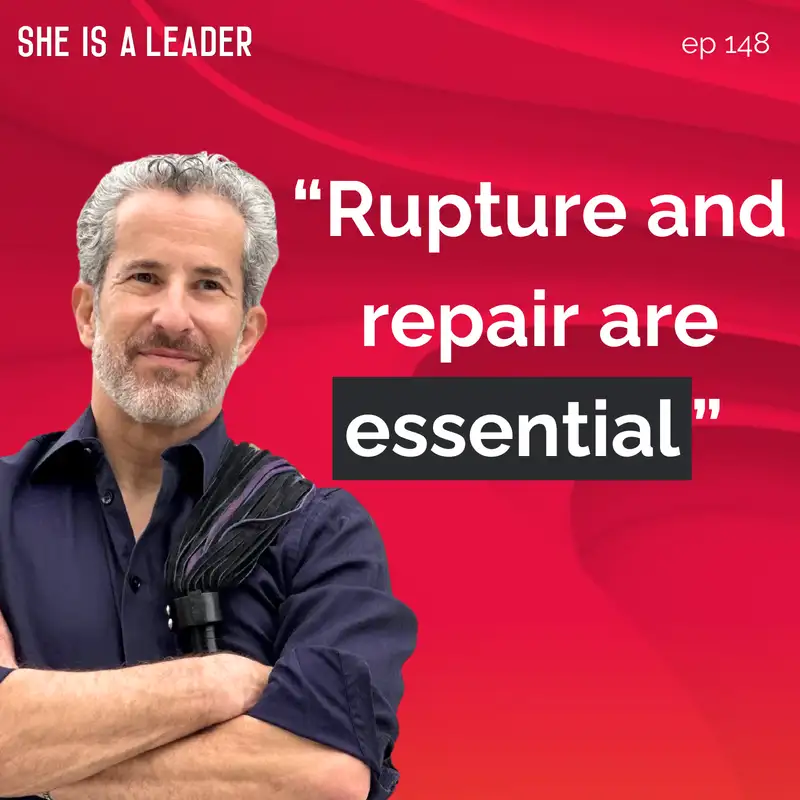
Yvonne Heimann [00:00:00]:
Have you ever noticed how personal growth or better communication can lead to unexpected shifts in your relationships both at home and at work? Today we're tackling the challenges of change, like dealing with grief when long time friendships suddenly end, managing the pain of feeling misunderstood and facing resistance from people who don't want to do the work themself. It is tough when boundaries get crossed, ruptures go unrepaired and resentment starts to build.
But there's ways through these rough patches. Joining me today for our final and third episode in our three part series is Matthew Riven, an expert in power coaching and relation transformation. Who's here to share his methods for conscious repair and clear communication, and to really skip that trap of lingering resentment. Now if you haven't listen to the other 2 episodes, I want to invite you and really recommend you go back and listen to those 2 past episodes too. These can be listened to as a standalone but they really work nicely with eachother. And in this specific episode, Matthew and I dive into tools like boundaries, debriefs and after-care, yes, I guess the after-care is not just for the bedroom, giving you practical insights to hear rifts and grow stronger connection. Expect real strategies and relatable stories so you can use them in your own life
Yvonne Heimann [00:01:45]:
And with that, let's dive for a moment into the people in your life are going to change and talk about that resistance. Because I think as humans.
Matthew Riven [00:02:01]:
You mean the population, the friends and lovers you have in your life are going to change as you do your work and you change.
Yvonne Heimann [00:02:06]:
Same with the team, right?
Same happens with team members too. It's the business.
Matthew Riven [00:02:10]:
See what I did there? Clarifying the communication.
Yvonne Heimann [00:02:13]:
When working on yourself, when working on your communication again, you're going to run into a situation where potentially the cat is chewing on cables again and we need to kind of shove them off the cable and go snuggle them. I'm telling you, you should be watching on YouTube, not just listening. It is way too much fun. Or we get, we get the tablet. Yep. Lucas, our video editor is going to have fun because we got a third microphone sitting just for the background and the cat just jumps on the heading on it. I'm telling you, you should be watching on YouTube and not just listening to it. However, if you're driving, stay on the podcast platform, please.
When we are working on communication, even when squirrel moments happen and working on ourselves, people that are not wanting to do the work, because that's what it comes back down to for me at least, people that don't want to do the work are really going to push back. They potentially just remove themselves out of their life, but might actually want to get you back in your box because that's where it feels safe. That's where they know you. That's potentially where they know they can play the game with you. There is so many things that happens and let's be honest, I think part of that also brings up the grief and brings up the pain of this was a 30 year relationship and now suddenly, poof, gone. What the fuck am I doing? Everybody is leaving me. Am I doing the right thing? What the fuck am I doing? I'm all alone now.
Matthew Riven [00:03:52]:
Actually, from my perspective, when that happened, there was a significant amount of grief at the relationship of 30 plus years ending, there was. Say again.
Overnight ghost. Not a word. No explanation, no discussion. No. Let's figure out what happened. This is why we're upset. This is none of that. Was there grief? Yes.
Was there hurt? Yes. A lot of it. Did it take a little bit of time for me to go, you know, did I screw up? Did I not? And looked at it and went, I gave a boundary and said what you did impacted me. And I immediately said, and we're fine. I just wanted you to hear that. And we're fine to find out we're not that needed to be talked about. At the end of the day, it's their shit, not mine. So to say that I was upset, acute with what happened during the situation, obviously, yes, because I cared.
But at the end of the day, I'm okay with who I am and who I've become. And I'm glad I stood up for myself and said, hey, that bothered me. And if you have a friend who says, that thing you did just now, Yvi, that thing you did, that was kind of offensive to me. Oh, my God, I'm so sorry. Can we talk about it? Yes. Great. Fine. Thank you.
Let's do that. That is a friendship, Yvi. That thing you did bothered me. Well, that's your shit, Matt, not mine. What kind of a friendship do we have? How equal is it now?
Yvonne Heimann [00:05:30]:
One thing I want to bring on here is just because we have been doing the rupture and repair, often every relationship will have a rupture at some point because how we perceive things, our own stories, things will happen. Now, what I want to clarify, just because some of our audience might not have done the work yet, is there is a difference between. Matthew, is it. Is it really me, or is this something in you where you might want to work with this, or that's your shit. There is a level of. There is a level of, has it really been. What am I trying to say? I'm not trying to point fingers on this. I'm trying to make the distinction between, I don't give a shit, it's your problem.
That level of just pushing it back at you or potentially saying, didn't intend this. Wasn't my intent to approach you like this, to hit you like this, to hurt you like this. But. And not. But. And do you think there's potentially still some work to be done on your side, too? To not be hit as hard as much with that. What am I trying to say here?
Matthew Riven [00:06:55]:
It depends on the friendship, the relationship you have with that person.
The simplest and best thing to say is to acknowledge the fact that there was something that was painful. Just simply say, I hear you. Yeah, that thing you did bothered me. I hear you.
Sometimes that is perfectly fine just to say, yeah, I hear you. Maybe you can offer, I'm sorry, don't have to just, I hear you in the heat of the moment to come back and say, yeah, but that's your shit. That doesn't help the situation.
Yvonne Heimann [00:07:39]:
By the way, the little language pattern here, Keep it in your mind. Keep it in your mind. Before I forget, don't ever use the but.
Matthew Riven [00:07:50]:
It dismisses everything that came before.
Yvonne Heimann [00:07:53]:
Exactly. So it's like, yeah, great, I'm sorry, but.
Matthew Riven [00:07:54]:
But the sorry doesn't exist.
Some of the language things. So there's a balance between what you can say and how you say it. And the intent and the impact can be wildly different. Your intent and so you have to have the rapport and the relationship with somebody. Especially when you're talking about significant others. Get out of the office and now you're at home to be able to say that was not my intent. If it's the 27th time something has happened, there is something there to work on. It's the first or second time.
Oh, my God. That wasn't my intent. I'm sorry for that impact. And the two of you need to start having conversations. I'm just assuming significant other two of you should be having conversations. Why did that impact you so much? I don't know. Not the right answer. Why did that impact you so much? And you don't have the conversation at the time, but maybe a day or two later.
Matthew Riven [00:08:52]:
Why did that impact you so much? It reminded me of a time when this happened. And now you're starting to figure out your partners triggers. Everybody has triggers. And most of the time it has nothing to do with the here and now, but something that happened again, going back to it, your family of origin. That triggered me. Because growing up, this is what always happened. And you get to look up and go, oh, my God, I had no idea.
I see how that worked. And you start building a connection with your partner. You mentioned the rupture and repair before. Blows people away. When I tell them this and I can show the research, whatever. In a relationship, a third of the time is going great, A third of the time is rupture, and a third of the time is repair. That blows people away who think my relationship is great. 90% of the time things are going fine.
90% doesn't happen. A third of the time things are going great. The rest of the time is rupture and repair. And the ruptures don't have to be significant. It could be. I'm sorry I was late today. I was very. I was disrespectful of your time.
I got caught up doing something else. I apologize for being late today. There was a rupture because somebody was frustrated that you were late. The repair was a couple of quick sentences. It was accepted. That's great. You move on. That's rupture and repair.
Now, if you let little ruptures build up for months and months and months and months, they become massive and the repair becomes that much longer and harder. If there are significant issues, whether you're saying you cheated on somebody or they found you just really bad mothering, you're bad mouthing your mother because she's really just a pain in the ass, that may be a problem and I was kidding on that. Pain in the ass. That may be a significant rupture that has to get repaired. But it's only a third of the time things are going well and it blows people away when they're like, well, my relationship's not going great 90% of the time. I need to find somebody new.
Yvonne Heimann [00:11:01]:
Two things that come to mind on that just to set the stage for us a little bit. Number one is I want to dive a little bit deeper into when you don't repair it and it turns into full on resentment.
The other one I want to also talk about. So we'll park the resentment for a second because I know that's going to be a little bit longer conversation. One thing that I love and kind of start to bring in my business too and in my personal relationships is a concept out of the kink community and that is actually pilots do it too. I'm going to. Yes. You just saw Matthew's face debriefing. Oh yeah, I saw it kind. And I always kind of brushed it off.
Back in the day I was involved in the aerial acrobatic scene. And when they do training, you have multiple pilots. Like you got one up front that actually manages everything else. And one of one is the only one talking to the tower. Once they've done their whole flying maneuver and all the things they do, a debrief of what worked and what didn't.
Matthew Riven [00:12:15]:
Which is different than aftercare. So we can hit on that.
Yvonne Heimann [00:12:19]:
So that's over. On the pilot side of things, I never paid attention to it. I'm like, yeah, cool, awesome. You talk about what worked, what didn't work. Literally just happened in my head when I'm like, oh yeah, it's the same thing. Because where I started really paying attention to it is in the kink community. You, you build a scene, well, I'm not gonna dive. Maybe we will.
Who knows?
You lay out a plan of what you want to do, what you want to experience, all the things then you have after care. Different than debriefing, meaning, heck, if you take it into an everyday life, I go for it.
Matthew Riven [00:12:54]:
So we'll get to resentment in a second. Building the scene. So when you're working with a partner, the way I do it in Conscious kink is you'll have a conversation with the partner in terms of what are your boundaries, what are your negotiations, what do you want to experience, what are your desires, all those kinds of things.
Yvonne Heimann [00:13:13]:
Clear communication. What a concept.
Matthew Riven [00:13:15]:
Relationships, boundaries, desires, meaning safety and aftercare. You discuss all of that beforehand. Run the scene. Great. The end of the scene. You're going to have aftercare, whatever that needs to be. Do you need to snuggle? Does your partner need to be like, look, I don't want to talk to you or see you for the next 20 minutes. I'm going to go take a shower.
Do you need food, whatever that is for your aftercare?
Yvonne Heimann [00:13:41]:
Do you need a wet towel?
Matthew Riven [00:13:44]:
Yes, exactly.
It could be something as simple as that.
Yvonne Heimann [00:13:48]:
It's just funny because us women appreciate the towel, but also sometimes lack the communication to just ask for it.
Matthew Riven [00:13:51]:
Well, and then we come back around for the full conversation. Having the conversation. So you have a negotiation beforehand. Aftercare is you're still in the heightened experience from the scene. So you have your homeostasis. You get to your expansion. You're going to, after the scene is done, you have a contraction smaller than your homeostasis. And then you're going to find your homeostasis again.
It may be new, but you have the expansion and you cannot just return. You're going to have a contraction. What is the aftercare that limits that contraction and helps you return to your normal homeostasis? Great. That's your aftercare.
Yvonne Heimann [00:14:35]:
Hold on there for a second. For everybody that might be watching or listening in, that's like, what are you talking about? Let me give you a everyday business example, because the same thing happens in business actually too. Have you ever heard about the conference hangover? It's the same kind of energy. It's the same kind of what's happening where it's like, oh my God, all of the fun stuff, all of the people. You have that expansion of learning, of meeting, of doing at a conference and afterwards you potentially have what we call a conference hangover. It's a hiding at home. It's something suddenly the energy drops. You potentially could even fall into somewhat of a depression where it's just that you lose all of that energy.
I know what I need to do. For me to quote after care myself after a conference, to not have that total drop off
Matthew Riven [00:15:31]:
At a conference, you might be like, oh my God, that was amazing. Yes, I will need to contact you. We've got great things we'll be able to work on and then by the time you get home, you, you never contact them. It just fades away in the conscious kink. The aftercare, the scene is done. You help them on their way. A few days later and it could be 24, 48, 72 hours, 96, 3,4,2,3 days later you have a conversation. What went well, what didn't, what do we need to work on? How can we make it better Next time you have a debrief, but you don't do it in the heightened expansion of all that energy and chaos and shouldn't be chaos, but all that energy and motion going on from the scene itself.
Another example, something goes awry in business. Take care of the acute. What just went wrong? We were 90% of the way done and all of a sudden just the product didn't work. The client is pissed. We've got to go repair that. Now is not the time for debrief. Right now is the time for quote unquote aftercare. Take care of what's going on from the acute nature.
Get everybody back on the same page. What do we need to do to fix the situation? Excuse me, I'm going to go talk to the client to get them off the roof. Hang on. Get all that squared away. Once the emotion is out of the way, then you have your debrief. Maybe it's a month later, after the contract's been fixed or finalized. Great. The product's been released.
Matthew Riven [00:17:03]:
What happened? What went wrong back in August? What do we need to do next time? There's a lot of overlap. There's a lot of similarity between business conscious kink and even the therapy methodologies. The work that I do with clients follows the same pattern. So that is where the debrief comes into play. You, you don't do it during the heightened emotion. You do it from a calm perspective without any sort of blame. So if you have to in a conscious kink situation, use a safe word, aftercare. Don't do the debrief.
Don't figure out what happened at that point in time. Something happened where the safe word had to get used. Everybody chill out, do the aftercare come down and a day or two later figure out what happened. That's where the debrief comes into play. If I'm not mistaken, I don't know if it's the same way or not. Years ago it was NASA who actually dealt with commercial pilot self reported issues. Not the faa, because it was a different organization, pilots felt safer self reporting of this near miss happened or this Runway incursion happened at this airport. I need to report this.
And I know I'm not going to be blamed for it because I'm going to a different agency entirely. And they'll do the work to do the accident investigation or the near accident investigation, come back with the report of how to make sure it doesn't happen next time. And everybody goes on their way. In a sense, safe matter. And you have people who feel comfortable reporting. It's kind of like that's the debrief investigation.
Yvonne Heimann [00:18:52]:
Bringing a coach, bringing a therapist, bringing a consultant into your business. It's an outside perspective that doesn't have a skin in the game.
It's like you're working with couples. It's not a blame game anymore because somebody perceived something in a certain way.
Matthew Riven [00:19:11]:
Or the intent wasn't intended, the impact was greater than the intent. And same thing with couples is, you know, if I look at if, if and just use the whatever, just one spouse looks at the other and says, I hate when you do this. This is really bothersome to me. The appropriate response at that point in time is, I hear you, let's talk about it. The incredibly inappropriate response is, yeah, well, let me tell you about the things that piss me off about you. Because now there's no, there's an intent to defend. There's no intent to learn. There's no intent to heal.
There's no intent to repair the rupture. It's just a blame game that goes on.
Yvonne Heimann [00:19:55]:
And it's like for me in business, when I come in as a consultant, I have the possibility to say, I'm here to help you. Doesn't mean I'm taking it to your boss. Doesn't mean I'm taking it to the board or whatever. Bring me up. Where is the problem? Jump on a call with me for half an hour, just dump it. I don't have an ego in this. I don't have any emotion in this. I'm just collecting data.
So now suddenly I become the outside, the unemotional adult that can be like, oh, here is the connection happening. Here's where the bottleneck is. Here is where the floor friction is happening. It's. I see it so often where it's like you wanting to go the same path. You are pulling in the same direction. You're just talking past each other.
Matthew Riven [00:20:46]:
Yeah, you're talking past each other. The, the. It's fun for me a lot is all the experience I have, and the beautiful thing about transactional analysis is you don't just learn it, you have to do it to learn. You have to go through the process.
No, it's not just book learning and not just being lectured. And you're not just sitting in a room seeing how it's done and then doing that work with others. You have to go through the process. You have to do it to learn it. And so you, as you just said, you clean up your own shit before you take it into the room. So I have done tremendous amounts of this work. And the beautiful thing about the combination of being this power coach for individuals, couples, groups, relationships, and having the background I do with the MBA and the business and everything else and going and doing some of the organizational consulting as well, is you come in with the same mentality and the same attitude. I need each side of the couple to feel comfortable telling me what's going on and the fact that I'm not going to take sides.
Matthew Riven [00:21:49]:
The only side I'm taking is the relationship. When I'm talking to people in an environment, corporate environment, I will talk to you and listen to you and hear what you have to say from no perspective of blaming or anything else. I keep my confidential requirements high. Both consent for what I can say. If you want me to tell your boss what you're telling me, I won't. That's confidentiality and that's consent. I will be more than happy to say generically what has been going on.
So that way people feel safe telling you, as the consultant or the coach, what's going on. I've done that. I'm doing it now with a couple of corporations. They just brought in a new. I've been involved in this group for about 20 years. They brought in a new consultant, and I'm talking to the consultant very openly because I want everything to work right. It's like, okay, hey, this is what's going on. These are your new ideas.
Well, let me tell you what happened 12 years ago. Why that may or may not work, because we've tried that 12 years ago, and this is what's changing. You need that open communication with knowing there's not going to be retribution, with knowing that you're doing it essentially as a debrief without the expansion and contraction and energy and emotion and raw vulnerability that you're going to have during aftercare.
Yvonne Heimann [00:23:14]:
Now, when that debrief is not happening, when that repair is not happening.
Matthew Riven [00:23:24]:
Mistakes are going to continue and they're going to happen over and over and over again and nothing's going to change.
Yvonne Heimann [00:23:27]:
Are we going to move into resentment?
Matthew Riven [00:23:30]:
So resentment, That's a question. Yeah. Resentment is going to be a bit of a different thing. If the same mistakes keep happening over and over again, you're going to get frustration from that.
Yvonne Heimann [00:23:43]:
You don't give a shit about what I'm saying. And then really 10,000 times, yeah, we.
Matthew Riven [00:23:45]:
Know this happens all the time. And I give up. And some of that's going to be resentment. Typically it's a little bit more from a relationship perspective. The best way to bring this up, ladies, is to talk about it sexually.
Yvonne Heimann [00:24:03]:
But you should know what I want, right? So more than that is this is. This is me. I have done that in the past.
Matthew Riven [00:24:13]:
More than that, to be blunt about this, if you have a partner who is not satisfying you and you're faking your orgasms and you're not telling them that they're not satisfying you and then you're pissed that they're not changing. How, how do they know that they need to change if you're not saying anything? So what's going to happen is you're going to be tired of the sex is just not good. So you're not going to want to do it. They're going to get frustrated, you're going to get frustrated. The sex, when you have it, is still not going to be very good because they don't know that they need to change. Nothing's ever going to change. And resentment will start to build. It doesn't have to be sexual.
It could be. I hate the way you load the dishwasher and you don't say anything about it. And they keep loading it in such a way that it just drives you nuts. And it's a little pet peeve, but it drives you nuts.
Yvonne Heimann [00:25:03]:
There's only one way to load the dishwasher right.
Matthew Riven [00:25:06]:
Now you're going to get frustrated. Now you're going to get frustrated with doing the dishes every night and you're going to take over and you're not saying anything, then resentment is going to build. Here's the thing about resentment. It wins, every time. There is nothing that will beat resentment. It doesn't matter how much you love the other person, doesn't matter how much you care, doesn't matter how much you want to get it to work. It doesn't matter how much you love them, want them or anything else. Resentment is a poison that will win.
Everything else goes away and it gets very, very hard to feel those loving, caring, wonderful feelings for someone. When there's resentment underneath the table, can it be fixed? Absolutely, no question. Can you get past it? Absolutely, no question. You can get back to the loving, caring, intimate feelings. The first example, you can get back to having passionate, amazing, intimate sex with your partner again. You can get back to feeling comfortable with the chores around the house again. But you have to work through it with a tremendous amount of vulnerability. It can get fixed, but it takes work and desire to fix it.
But the worst part about this is nothing beats resentment. It poisons everything that gets in the way.
Yvonne Heimann [00:26:37]:
So if you're ready to do the work, you know what to do. You'll find all of Matthew's information in the description. Wherever you're watching, listening, reading, whatever you're doing, you'll find it. And I have a feeling at some point we are going to have you back. It's kind of like becoming, becoming a staple on the podcast.
Matthew Riven [00:26:59]:
I appreciate that. These are always, they're good conversations. They're free flowing, forming conversations we touch on a lot. There's always a lot more to talk about. Your listeners have been receptive and I appreciate being here every time. Thank you.
Yvonne Heimann [00:27:12]:
Thanks for coming on again. And with that, if you haven't subscribed yet, what are you doing? Go hit the subscribe button. More episodes are coming and I hope I'll see you then because my faces on the podcast are way too much fun to just listen to it. Bye everybody.