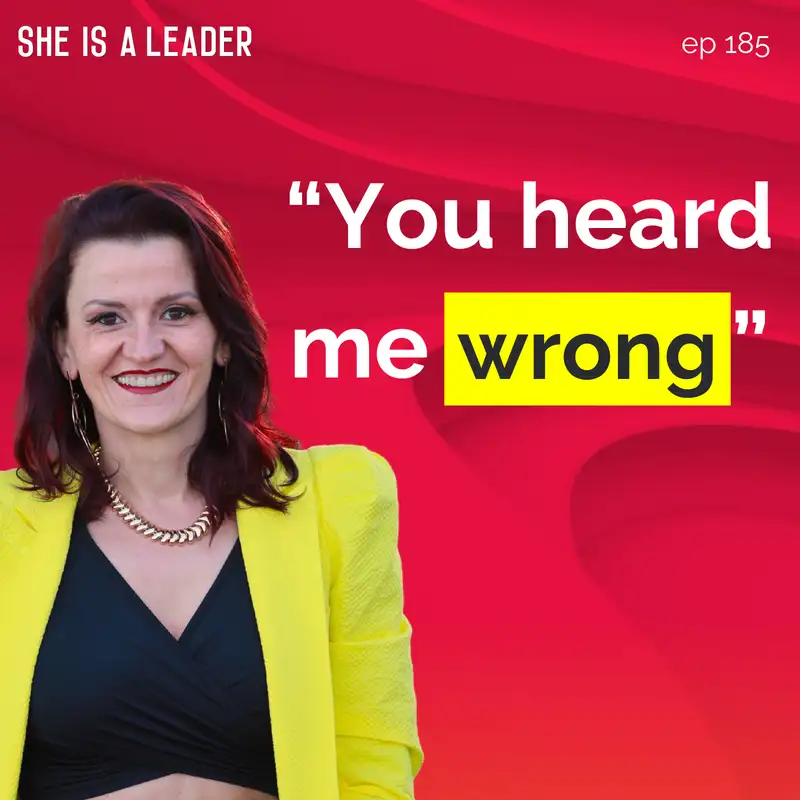
Yvonne Heimann [00:00:00]
Years ago, I worked as a server in a restaurant. My first husband worked in the kitchen. I was working front of the house. He would speak German to me, nothing unusual, just our language, right? So explaining daily specials was just simpler at that point to me to get them in German language because I was still translating into English, right?
So nobody else on the team was speaking German other than us two, and to them, it always sounded like we are fighting, and what we actually were talking about were the daily specials. We weren't fighting. It was just what German looks like and sounds like to others. You might have seen on Instagram or TikTok the, uh, the jokes about German language. You hear the French, you hear the Spanish, and then you hear the German. That's just what that language is. Sharp, sharp, direct, no fluffy, no, no cushion between the words. That's how I still talk, even in English to this day. A to B, it's a straight line, right? I don't fluff things up. I am to the point. When I ask somebody how you are doing, I really want to know.
Yvonne Heimann [00:01:31]
And if you're new here, this is She Is A Leader, the show for women who are done waiting for permission and ready to build, lead, and scale their business on their own term. And I'm Yvi, your host. Also Yvonne Heimann, tho, at this point, I think everybody knows me as Yvi. You already know what it feels like when someone's tone just lands wrong, right? Even though nothing is wrong. There's the question of, "What did I do? Why are they so harsh?" Believe me, I, I experience that a lot with my language and just being this, "Ugh, that's German," right? And here's the thing I had to face. I can be direct, I can often leave emotions completely out of how I talk, and it can still land quite emotionally and like a gut punch for the person that's hearing it if I don't check in what they heard.
Notice the next time your tone gets read as something you didn't mean. Yes, we Germans are the perfect example for this, and also it happens in every single language By the end of this episode, you'll understand why emotions matter in a conversation. I hope you'll know just how to communicate more clearly starting today.
So let's get into it, because I've done this a couple of times over the last few months. You might have seen... Listen, if not, go back. You're gonna love this episode. I've talked in a specific episode, we'll link it in the description. You don't need to listen to it right now. You can listen to it later, just to get more of the background info.
Yvonne Heimann [00:03:31]
I've done an episode with Matthew in the past, where we were talking about how I nearly never made it into a community that I actually quite liked. And I had reached out, I had bought a ticket for a dinner. I had bought plane tickets, I had made plans, all the things. And had already thought I had a rapport with them, sent some feedback without any fluff or AKA explanation, and it blew up in my face because it didn't land how I wanted it to land.
And you can go listen to the episode. And interestingly enough, yes, I went to the event. Yes, we straightened it all out. We cleared it up. We, I explained my intention, and it was a great evening. Had so much fun, and made some real connection. Then the interesting thing was we ended up in this, "Yeah, next time just let us know you're German, and it's all good."
So it's, it's this known personality trait of Germans, where it's like, "We are straight to the point. This is how it is, and this is..." Yeah. And honestly, if we take emotions out of things, we can't get hurt, right? Ah, wouldn't that be nice? And I did, I did get my closure, right? We were able to straighten it out.
Yvonne Heimann [00:05:12]
We were able to clear this up. We had a couple really good laughs and an amazing evening. And it comes back around to sometimes I get so efficient that you learn... That you miss the lesson in everything. You know, you can, especially now with AI, you can shortcut so many things, right? I shortcutted a webinar the other day because I'm like, "Let's see. Let's see what take she's taking." Took the transcript, send it through, and I'm like, "Yeah, I don't agree with that take. Don't need to watch the whole thing." And we can shortcut quite a few lessons, and when it comes down to something like this, though, that shortcut potentially could have hurt me a lot.
This person could have been like, "Screw you. We are... No, I don't care what your intent was." The fluff around the emotions, the explanation, the storytelling, the little extra on top of the German efficiency, that is where the lessons come in. I could tell you, "Just do this," right? But without you hearing my story, without you hearing the, quote, "hero's journey" that I went through, it wouldn't land the same way of me telling you, mm, my last solo episode, build you build your business on passion.
If you wouldn't have everything around that, you would still be like, "Yeah, go. I'm not building a business on my passion. Why would I do that?" We need the emotions with it, and we need the efficiency, too There's times for bringing the emotion in, bringing the little, little sparkle of magic, and the additional story, and taking the time to explain your intent right away, and then there's times to just get shit done.
Yvonne Heimann [00:07:48]
Sometimes even after we learn this lesson, they come back around. They're... I'm new to Austin, right? Even though I'm not in Austin right now. I'm in Canadia. Loving this evening. Sometimes these lessons come back around. I'm new to Austin. I'm new to the Austin kink community, and I'm a helper. Working on that one.
You might have seen one of my shorts where I'm talking about asking for consent. Yes, in the kink community as well as as a coach. Helper means in a, in a bad way. When I use the word, quote, "I'm a helper," it often has a bad connotation of I'm just stepping in, or I'm doing additionally, or I'm doing too much, or I'm telling people what to do and how to do. That, again, can cause quite issues where, in this case, it can land as patronizing or somebody thinks they're superior, right? When underneath, what it often is is just slow down. Sometimes it's really just not doing the extra mile. It, it might just be trying to take care of somebody else while you're still learning.
It might come back around to telling somebody too much rather than asking questions, assuming a role. There's a lot that can happen there. There's a lot different variations how this can manifest and show up, and I think, I think the fix here isn't necessarily to be less direct. Again, communication, the goal is to make it impossible to be misunderstood.
So I don't believe in being less direct with that But ask how it landed. Ask... What we often do in the company is I repeat what I heard because it's not just even emotion. Sometimes we hear different things than they were said because of the filter we are hearing things and seeing things. Let your team repeat what you just said.
Yvonne Heimann [00:10:05]
What did you hear? What did you hear me say? Check... That, that checks in of did they hear what you wanted to say, or did they have their own perception of it and change things in the way they gave it back to you? Always ask for, "What did you hear? What, what are you hearing me say?" That way you can nip it in the bud right away, especially with close friends or in business where you, you don't want things to fester.
Once they fester... And use more words. Don't tell me, like, "Do this." Use more words. Explain why and not just the what. Why are we doing it? If you go back into my "Somebody Nearly Coached the Passion Out of Me" episode, I talked you through the why, why that is not something for me, so you can make the decision if that is potentially something for you.
And remember, good intent is not the finish line. Yes, I always, people always have my trust. I always believe good intent first, and also, I perceive things as not a good intent when there is... Oh, my God, one of the biggest thing of my- things of mine is, "I want this," rather than, "I would like this." I want this, has this German, "Give me the thing."
That, that's how I perceive I want rather than I would like, and I know it, which means I'm rephrasing that for me. I'm, I'm, it... I know how to manage that perception so that the intent for the person saying it is still there. I know that about me, and there's other words or other phrases that come across differently as they were intended.
So make sure that you check in. If something doesn't land right with you, check in on the intent, just like my, my dinner host did with me. Now, I checked in on the intent. I, I caught it wasn't her job. Just because you mean well doesn't mean it lands well. We need to take responsibility for us when we do that.
Yvonne Heimann [00:12:25]
Next time something doesn't land right, g- go back, go back to my kitchen story. Seriously, it was really just the daily specials, and they thought we were fighting. I, I s- still laugh to this to this day. And the, the, that gap between what I meant and how it landed with that dinner email and trying to fix some things
That's just, that's just being human. And heck, considering I'm a systems and efficiency person, oh my God, do I sometimes take the human out of my language. I put my human back into systems, but sometimes I lack it in the communication. And if this hits home, send it to a woman that needs to hear it. Send it to a woman to let her know it's okay to tell stories.
It's okay to show emotions and share emotions. It's okay to not always be the most efficient person in the room with your language. I'll see you in the next episode