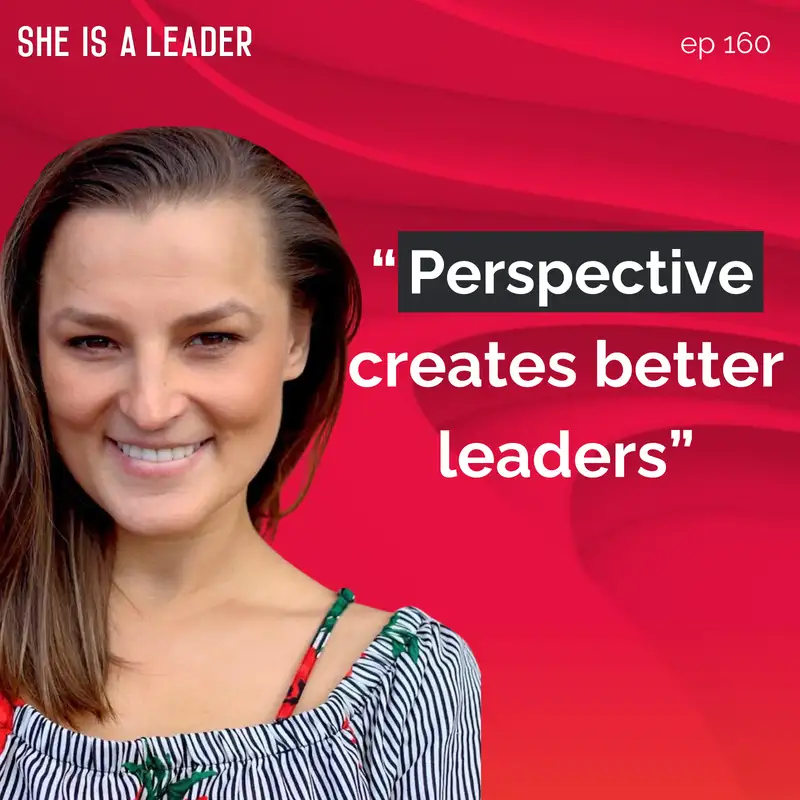
Yvonne Heimann [00:00:00]:
Welcome to She Is a Leader, the podcast where we celebrate the real story of women who lead with courage, vision, and heart. And today's guest is somebody that also has been on the podcast before and who truly embodies what it means to be a global leader. Michaela Anderdal, marketing lead at NimbleCRM. Michaela's story is one of crossing borders, both literally and figuratively. Born and raised in the Czech Republic, and I'm pretty sure at that point it was still Czechoslovakia. We're going to talk about all of that. And she built a thriving career in the US tech scene before making the bold decision to move back to Prague to be closer to her family. Along the way, she navigated the challenges of working across cultures, leading international teams, helped building a brand that resonates worldwide.
In this episode, we'll explore how Michaela's bilingual, bi-country journey, I think there's even more than just two countries in that journey, and how it has shaped her as a leader, the lessons she learned about resilience and adaptability, and how her personal story continues to influence her work at Nimble. If you've ever wondered what it takes to lead with authenticity in a global world that is becoming more and more smaller than it ever has been, or how to turn your own unique background into a superpower, this conversation is for you.
Yvonne Heimann [00:01:45]:
And I'm so excited, Michaela, to have you back. And I'm bringing my German back. I think you usually pronounce it a little bit more with a K. Girl, I am so excited to have you back and talk about what it takes to really work in such a small world nowadays. I'm like, we both have experienced it with two languages, multiple countries, all the things. For everybody that hasn't met you yet and hasn't listened to the former episode, which by the way is still on YouTube, guys, Um, give my audience a little bit of rundown.
Who are you and what the hell am I talking about with this whole country thing and language thing and all this stuff?
Michaela Underdahl [00:02:30]:
Yes, well, first of all, thank you for the beautiful intro and for having me back again. So nice to be here with you. So I was 25 years old when I decided to move from the Czech Republic, from Prague to California in the United States. Until then, I lived with my mom. I had never moved before, which very quickly changed when I moved to California. I think within a year I moved 8 times. So that's kind of where I, from just a little girl from Central Eastern Europe who just like didn't really travel before, I became a nomad basically. Basically, um, and I moved there with no network, not knowing anybody.
So it's been really interesting experience to start from scratch because especially you mentioned that I have since moved back home, so I can see how much easier it is now when I have the network to lean on, and not just professionally but also in my personal life, which was also a big part of why the decision was made. So let's actually go back to where my professional journey started when I moved to California. I, I'm actually a political science Eastern European studies major. I don't have a technology background, I don't have a marketing background, and I just wanted to find a job that wouldn't just be a job, but something I would feel strongly about, uh, about. I wanted to find a brand that I could relate to, and therefore it would be much easier for me to, you know, build my career and work hard. It's much easier to do that when you feel like it's, it's, you're selling something that helps people. Um, so I was applying all over the place and actually came out. I just saw this ad and Nimble was hiring for customer success people and they literally said in the ad, we, we will teach you the technology.
Michaela Underdahl [00:05:00]:
So we, they said that they like liberal arts majors, that they want people that are passionate, that are people people, and they care about customers because it's important to serve them well and offer good customer support. So that's where I started. And over the years, I moved from customer support to social media, community management, and I've done basically anything and everything in the marketing department. And 3 years ago, we decided to move back and I've been fortunate enough to be able to continue to work for the company remotely. So that's a little bit of my background. I'm sure we will go deeper into certain aspects of that, but I just didn't want to get sidetracked too much because it's easy.
Yvonne Heimann [00:05:55]:
Oh, there is, there is so much, which is one of the reasons why I also wanted to have you back, right? Because there's so much to our stories and I love that, I don't want to say aloud, that Nimble made it possible for you to stay with the company because there is a lot of companies out there, especially in my circles that I'm talking with, where not everybody is an entrepreneur, right? I'm fortunate enough to be able to grab my laptop and grab the setup I have now and go. I'm like, I've been doing it for a year now all over the place. However, there is quite a few people in my, in my community still that are able to travel the US and the US is fine, but they are not allowed to step outside of the US and work. And I'm like, don't get me wrong, I get in certain levels of certain businesses, there's a security issue and there's certain things that happen with that. And there is tax qualification if you're somewhere longer than 6 months. Now suddenly we have the whole tax mess behind it.
Michaela Underdahl [00:07:02]:
Very complicated business.
Yvonne Heimann [00:07:04]:
And oh my God, I wish at some point our governments, all of them, are finally just getting their shit together because it's like this world has become so small. So I'm really happy that Nimble and you were able to do this because again, the world is getting really, really small. I think it also speaks to the, what kind of company Nimble is, because I don't know about you, but I ran into a couple of people that thought I was less smart because of the accent I have. However, I believe that because we've experienced multiple different countries, because we have experienced multiple different ways of living, of thinking, that we bring such a wealth of knowledge and a different point of view to work that I think next to your amazing personality Nimble has seen. So I would like to bring this question back to you. So this was all my experience where it's like, yeah, I can look at something from 10,000 different ways and believe me, my upbringing was different than anybody in the States. How, how was it for you growing up in a country like the Czech Republic where there's a lot of limitations, at least in the past? I don't know how it is now, but at least in the past there's a lot of limitations, there's a lot of things that are way different than it is in the States. How has that shaped how you show up nowadays, how you engage with the Nimble community, how you show up in position at Nimble?
Michaela Underdahl [00:08:57]:
That's a great, great question. It definitely was my upbringing here and even who I feel like I was when I moved there and when I started working at Nimble was different. Like, you know, for us, like, I don't know, late '80s babies growing up in the post-Soviet Union and Iron Curtain era our parents still had lived in the tough communist era. Like, you learn from that, from what they say, how they interact with people, how they perceive their bosses, or what they're allowed to say and do at work. That was very different. And I feel like, um, I feel like we are strong. We never got any participation awards. It was one winner and that was it.
So like, I feel like we don't expect that. We don't expect to get in things for free. We expect to work hard. And with specifically Czech people comparing to Americans, I always say I wish there were, that I wish that like Czechs, I think it's happening. I think it's happening. But what I'm trying to get to is that I feel like a lot of Czech people and like people from here that I know are very smart, very educated. They speak multiple languages and they just don't have the confidence to sell it. So when I moved to the States, I very quickly learned that being perceived as somebody who's not confident, that's bad.
Michaela Underdahl [00:10:48]:
That's bad. You can't do that. You can't show that. So I have to work really hard on it and like to speak up and not to be worried about hearing somebody shutting down your opinion, like just growing, like not feeling like, you know, small. Like I was like that. I was very much like that. So that really helped me grow in this area. And that's like one of the biggest difference and biggest things I had to overcome, just I think Americans are great at it.
They had great presentation skills. They know how to sell themselves and they're so confident. And even like even school children, you can already see the difference where like to what I was at their age. Like I just listened to like American school kids and I'm like they are so confident and they're so good at public speaking and they're not afraid. I love it. Like they're going to have it so much easier in life than, you know, like us that were kind of like feeling like you shouldn't stick out because that was from that era back in the day. Like you were not supposed to be seen and stick out and voice your opinions because you actually could have ended up in jail. And like, I think there was kind of like, I don't know, like you kind of extract it from your parents and grandparents because they still like, they lived it and they still had it.
In them so strongly.
Yvonne Heimann [00:12:21]:
It's interesting. It's interesting how we both came to the same perception because one of the reasons I went to the States was I was tired of being humble. I grew up similar to you where it's like, you better be quiet and fit in because if you stand out and you are different, as you mentioned, you potentially ended up in jail. And that's, anybody that's listening right now, we are not joking. We are really not joking, especially still in East Germany, the wall still being up. We needed to fit in because the moment you stood out, you were a problem and that potentially got you in jail. I still remember waiting in lines for bananas and all the things too. It's just a complete different upbringing.
Yvonne Heimann [00:13:11]:
And I when I moved to the States, I was tired of being silent, of being humble, of not being allowed to be proud. And I'm not saying that's the law, it's just how I was brought up. And it's one of the things that brought me to the States where it's this, this boisterous, this outgoing, this I'm proud of myself, sometimes maybe a little bit misplaced and a little bit overdone. So guys, can we just find kind of like middle line between this whole humble and proud thing. Well, that's a whole nother, that's a whole nother podcast episode. And I'm curious, with you now having moved back, and I'm not going to tell the whole story, I'm going to let you choose how much of the story you want to, want to share. I know why you moved back, and I know, um, there's also a little one that was involved in the decision of moving back. Looking back at, at all of this, has, has your view of the world and the States and the pride and the strength and, and just all of it, has it changed since you moved back? Or I guess where I'm coming to is I often see life as kind of like a pendulum.
Yvonne Heimann [00:14:41]:
Um, it starts on one side where I'm like, oh my God, I'm, I'm so humble and quiet in Germany, I don't want it. It went all the way to the states of being really loud and being upfront and all the things, and it kind of like starts penduling in the middle where I'm deciding now, where is my next season going to be? And I'm curious if you experienced kind of like a similar pendulum in, in this journey of now kind of leveling out and how this was for you.
Michaela Underdahl [00:15:11]:
Yes, 100%. When I lived in the States, and I also, I mentioned I moved, moved there within the States, within California or within Los Angeles. So when, when I went there, I went from Prague, which was nothing like the Prague now, but it was still very open-minded and, you know, like fun place. But, you know, not too many cultures in comparison to California. But when I moved to like first north of LA and then into LA, many times people ask me like if there was like a culture shock. I'm like, No, it was just like more free. And I love that about LA where nothing was weird. Like literally you were like expected to stand out a little bit, show your personality.
Like the group of people I had there was very like diverse. Everybody had big personalities. And so That was kind of interesting to see. Um, back to the, and then, then I moved to Georgia. Um, so then the, that, that was definitely a culture shock. Um, don't want to get into it too much, but it was, uh, 2016, and we lived south of Atlanta, so suburbs, quiet. Uh, it was very different, very different. Um, very interesting time in my life.
Michaela Underdahl [00:16:52]:
Um, but you you talked about like how, um, sometimes you need different things at different stages of your life. Uh, definitely when I lived in the States, when I was working there, especially when I was working in person with the team, like it was a great environment to like really grow and absorb as much as possible. And I think like you can, um, you can really get sucked into the, like, building the career and succeeding. And like, I feel like Americans are very driven in general. Like, it's important for people, the status and the titles and all that is very important. You usually, when you go to parties, like, it doesn't take very long until somebody asks you, what is it that you do? And where you work and stuff like that. But it's if you want that, and I feel like at that time I really wanted that. That's what I wanted to focus on.
Michaela Underdahl [00:17:58]:
I wanted to just learn as much as possible, meet as many people as possible, and, you know, work on my career. So it was a great environment for that. And then I had my first child, and then I had my second child, and then For a little time, I tried to do it all. You just can't do it all. You just can't do it all, especially in my situation where my husband has a demanding job and he travels a lot. And then COVID hit and I didn't see my mom for 2 years. I couldn't really like, you know, hang out with a lot of people or I didn't even really want to because I had a newborn. Essentially, born in 2020.
Michaela Underdahl [00:18:44]:
So then the isolation happened and people started to be more negative. And then I was, I have to tell you this, I was so naive at the beginning of the pandemic. I naively thought that this will bring us together. We, I think we needed this. We needed this this common enemy, which is the virus. How naive was I? That, you know, we'll just try to be together and then it will solve a lot of our anonymous, and I don't think I'll be able to use that word, but like, you know, adversaries and like a lot of the negativity we had towards like people that are different than us. So that's very naive of me. Um, so that time of my life, I tried to do it all, but it, I realized I couldn't, and I had to move back because, uh, even though we had my husband's family there, they were still far, far enough, and I just needed more support as a mom and as a friend and as a human, because I'm very fortunate to have my best friends.
Michaela Underdahl [00:20:17]:
I've known them since kindergarten or elementary school. I just had dinner with 3 of them, uh, 2 days ago, and these are genuine relationships where we've known each other for our entire life. We've lived through so much in our lives and it just like refills your cup when you hang out with these people. And I lost all that during COVID Like when I lived in the States before COVID and before kids, I traveled a lot. It was not a problem. I, uh, I saw a lot of beautiful places. I met a lot of great people. Um, but then when like the world just became tiny, 4 walls in the bedroom and that's where you operate and everywhere you look and everybody you talk to is negative.
It like, you know, it really affected me. So I needed to focus on myself, my family, and definitely it's true. It just swings. Sometimes you need this in your life and sometimes you need something else. Yeah, that's how it is.
Yvonne Heimann [00:21:36]:
And I think all of that is what makes you so amazing in your position because you have seen the whole spectrum, the whole spectrum from, I always say life being just life, right?
We, yes, we grew up in a different situation, in, in a different environment, in in a different thinking, in a different energy. It's like it just completely is different. And it's, to me, it's, it's never good nor bad at that moment because we are in it, we are living it. We, we don't necessarily see it from the outside. It wasn't all bad for everybody that hasn't experienced it. Yes, there's bad things about how the country was at that time, at least with me in East Germany. Don't get me wrong, there were bad things in that, but there were also a lot of good things. And then you get to experience a complete different situation, a complete different country.
Yvonne Heimann [00:22:43]:
And I think all of that combined is part of your amazing personality and the conversations we have behind the scenes and how you engage with people, how you support other businesses in your position and do all of that. Now I'm also curious more on, on the Nimble side of things. I love and I believe all of this knowledge, how your upbringing, your personality, all of this together is an amazing asset for Nimble because we have behind-the-scenes conversation too, right? I know even more than my audience gets to see. But I'm also curious about the potential struggles because you mentioned you were actually working on site at some point. Now we are looking at, let me calculate really quick. PST to Prague, I think is a 9-hour difference. EST is a 6-hour difference. So it's not just a little bit, it's not just an East Coast, West Coast time difference.
Yvonne Heimann [00:23:53]:
It's nearly a complete swap. I'm like, yeah, it's not 12 hours, but you are limited to potential one-on-one time in Europe versus the States of like a few hours in the morning and a few hours in the evening. So how does that affect your work, your position, all of the other things? Is it a problem? Have you, you have figured out a way somehow because you probably wouldn't be at Nimble if you wouldn't have found a way. But what does that look like?
Michaela Underdahl [00:24:30]:
Yes, the team is all over the place. The team is in California, the team is in North Carolina, the team is in South Carolina, the, you know, team is in Ukraine. We have probably team members in other countries, but these are the states and countries I work with the most. So, Nimble has always been very supportive and flexible. So if things don't work out at the scheduled time and they're not absolutely like, you know, it absolutely cannot be moved because the world would end the next day, it gets moved. You know, things happen for everybody, even for the people that are always in the same time zone. So Just trying to figure it out. I don't, I'm not saying it's not difficult because having a call starting at 6 or 7, sometimes later PM, when you have children that also are doing bedtime or children that were at school the whole day and that's actually when they need you, that is difficult.
Michaela Underdahl [00:25:41]:
So it's, you know, there is no such thing as work-life balance. It's just trying to juggle balls in the air and, you know, sometimes they all fall and sometimes you keep them in the air. Yeah, just, you know, just, just doing it. But like I said, it's, they're very flexible. So if I really need to, I excuse myself from some meetings or we just see if there's a different time on the calendar the next day maybe, and usually it's not that big of a deal, honestly, you know, so just trying to make it work.
Yvonne Heimann [00:26:23]:
For, for my audience out there that might be thinking about, hey, maybe go crazy like me and go full nomad or, um, switch countries, move abroad, whatever big step it is and they're hesitant, they are like, oh my God, can I really do this? Where, how? I think we both have gone through a few of those questions. Do you have, do you have a tip for them? Do you have a recommendation for them, for anybody that's like, I really want to do this, but I'm also afraid of doing it?
Michaela Underdahl [00:27:02]:
Do it. It's scary, but do it. It's It's time to do it. It's now when you can, like, when I mean, I kind of just like, I just kind of did it. And then I kind of started hitting the walls. Like, I thought this would be easy. What is a credit score? How do I get a credit score when they don't give me a credit card? Okay, well, let's figure it out. So I've been working on my credit score for 8 years.
Michaela Underdahl [00:27:39]:
But it was like so much easier. I was 25 and I didn't have children and I was just braver. And then later when I already made the move from, you know, across continents with children, it was kind of necessary. It really had to happen. But if somebody is just afraid of doing it because it might be hard, but they can, I just say do it and then everything that comes in the way, everything they'll have to figure out, like different system, different healthcare systems, different social system and different tax systems, like that will help you so much. I never really like being on the phone and calling somewhere. Oh, I very quickly had to learn that because I had to figure out how to use the, you know, health insurance and I just had to just figure it out. Just a ton of research and just calling places.
Michaela Underdahl [00:28:43]:
Sometimes they thought I was completely stupid. They had no idea what I was trying to do and I had no idea. Like the system is such so much different that it really, I mean, it sounds like a cliché that, you know, it will make you grow, it will make you stronger, but it will. And also when people now, people listen to my children just speak in English natively. And I know I, I spent so much time and even money. I went to language school to learn English and then I would like watch TV shows and movies and I would like write down the words I didn't know and then I would like practice. How to pronounce them correctly. So I didn't want people to, like, you also talked about that, how you don't want to be perceived like somebody less intelligent just because you have an accent, which is complete bullshit.
Michaela Underdahl [00:29:41]:
I don't believe in that anymore. Like, but I thought that's how people saw me. But a lot of people, and I would even voice it. So a lot of people told me back, like, no, on the contrary, like, we only speak one language and you're telling us all these things in like your second language. And, you know, So what I'm trying to say about the language is that people are like, your kids are so lucky, and they are, because you, I feel like there must be exceptions, very regimented and smart and organized people that are able to learn a foreign language on their own, but I think the majority has to have to. You have to be thrown into somewhere where you have no other choice but speak the language and kind of get unstuck. So just do it. And what if it doesn't work out? Then it doesn't work out and you can come back, and at least you've had the experience.
I had a friend who tried to live in London and it wasn't for her, so then she came back and It was an experience. She didn't lose anything. She wanted it. She tried it.
Yvonne Heimann [00:30:58]:
I'd rather try it and learn it's not for me than not have tried at all. And one of the things I tell my people is like moving across country, moving across the big ocean is really not different than moving from LA to North Carolina. It can be just as stressful, just as crazy. And you know what? It is worse asking yourself what if than just testing it out and going for it and knowing, cool, awesome, love it, don't care for it anymore. I'm just going back and trying the next thing. And also, I think we both, we both agree on the just do it.
Michaela Underdahl [00:31:46]:
Yeah. People don't usually regret the things they didn't do. You know, so when you look back at your life, you would, you know, maybe that's the other way around. Like when you look back at one point in your life, you would regret not trying. You wouldn't usually, you know, don't feel just content at staying at the same place or not taking chances, not trying new things.
Yvonne Heimann [00:32:22]:
And with that, thank you for joining us for this inspiring conversation today with Michaela Underdahl. Your story is to me a powerful reminder that leadership isn't about where you start. It's about the courage to cross borders, embrace change, and lead with your whole self. And if Michaela's journey resonates with you, please share this episode with a friend or colleague who is navigating their path across cultures and careers. And don't forget to subscribe to She Is a Leader for more stories of women like Michaela who are making an impact around the world. Until next time, keep leading with purpose wherever your journey takes you. Bye, everybody.