Yvonne Heimann [00:00:00]:
Welcome back to she Is a Leader, the podcast where we dive deep into real stories behind women who are redefining leadership on their own terms. If you ever felt like you are carrying the weight of your own business or wondered how to break free from the constant hassle, today's episode is for you, our guest, Melissa Aarskaug. And I'm going to have to ask her on the episode if I actually pronounce that right. It is a really interesting spelling. I'm going to have to ask her where that name comes from. She is a visionary in cybersecurity and technology, fellow nerd right there, and the founder of Executive Connect Experiences. And her journey isn't just about building a business. It's about reinventing herself, overcoming burnout, and learning how to lead with intention instead of exhaustion.
In this conversation, Melissa opens up about the pivotal moments that changed everything, the habits and systems that helped her reclaim her freedom, and the mindset shifts that allowed her to thrive as both a leader and a mom of four. Stay tuned because Melissa's story is packed with honest lessons, practical wisdom, and the kind of inspiration that will have you rethink what's possible for your own leadership journey.
Yvonne Heimann [00:01:28]:
So let me officially introduce you to Melissa Aarskaug. She's an executive in cybersecurity and technology field, the visionary founder of Executive Connect Experiences and co author of the Renaissance Redefining Success for Modern Mavericks. She created Executive Connect Experiences as a purpose driven platform to help executives, founders and ambitional professionals growing, grow and scale their impact. As host of the Executive Connect Podcast, Melissa curates conversations with C suite leaders, innovators and change makers exploring the intersection of business strategy, personal growth and reinvention. Through her work, she fosters meaningful connections, resilience and bold transformation while bringing a unique perspective shaped by her career in technology, security and leadership. Now for everybody listening in, we also just realized we are both in the same city right now.
Gotta love the nomading style. Melissa, welcome so much to the episode. If I would have known that we could have recorded in person.
Melissa Aarskaug [00:02:40]:
Thank you for having me. I'm excited to talk to you today and your listeners.
Yvonne Heimann [00:02:45]:
Now tell me, the spelling of your last name is really interesting. Do you know the story behind it? Where it comes from?
Melissa Aarskaug [00:02:52]:
Yes, as a matter of fact I do. It's Aarskaug. Pronounced Arskog and I am Norwegian but I am also a little bit German myself. So thank you so much for asking. To pronounce it, it rarely gets pronounced correctly
Yvonne Heimann [00:03:07]:
And it's for me specifically it's like okay Am I using my European pronunciation, the English one? Yeah, it's always quite interesting. And then Norwegian heritage explains the extra letters in there. Norwegian language has quite an interesting spelling. And I'm curious. Let's start from the beginning. Take me back for a second of to that moment. What first inspired you to create your Executive Connect experience? What happened in your life at that point? What got you started? What was that moment of this is what the world needs?
Melissa Aarskaug [00:03:50]:
Yeah, for me it was. I often ran that narrative leaders or readers. And so if I read enough books, I would know enough to be a leader. And so I started the podcast because I realized the best leadership lessons did not come from the books. They came from conversations with people actually building things. And I learned that the more I kept reading books, I felt like I didn't fit in any of these books. I was very young in my career and leadership. I was very young in rooms that I didn't fit.
And there wasn't a lot about, you know, burnout and mindset and what I was going through as, you know, a young woman and a very powerful male dominated field. And so, you know, I had to be, I was in rooms where I had to learn really quick on the fly and fast. And so why I created Executive Connect was to share, you know, tips and tricks and tidbits with people from people that actually are doing big things in our world.
Yvonne Heimann [00:04:59]:
I think we all know Burnout, we all have experienced Burnout, and many leaders just simply face burnout. I'm curious for you, how did your burnout look and feel like for you and how did you know it was time for a change?
Melissa Aarskaug [00:05:21]:
Yeah, I think, you know, it was a couple of things. You know, as a high functioning person, an ambitious person, a strategic person, engineering person, we tend to have a lot of, I call it, I have a lot of tabs open, as I call it. I don't know if that's the right terminology, but I have a lot of tabs open always. And so I'm really functioning in all of those tabs every day. And I'm expending a lot of energy making sure I've checked all the boxes, done all the top things for every one of those tabs. And I think, you know, it wasn't until my son, you know, I was probably in my 30s when I realized how much I was functioning on a, like detox, retox, rest, repeat cycle. And it really came from the people I love. They're, you know, I'd be having these dialogues and I'd be like, yeah, yeah, yeah, yeah.
Melissa Aarskaug [00:06:15]:
And then I'd. They'd ask me a question. I had no idea what they were saying. And I realized I was still working and living in all these tabs and not really present and mindful. And here's the kicker about that. I've been a long time practitioner of yoga and mindfulness. And so when I was in these tabs all day, I wasn't practicing the skills I knew really well, which is being present and mindful of my surroundings. And it really just became something that, you know, was the hustle culture.
I was running on this hamster wheel every day, all the time. And it wasn't until I got off that hamster wheel that I realized I needed to change who I was becoming.
Yvonne Heimann [00:06:54]:
I use the same phrasing with all the tabs open, and I know exactly what you're talking about. And it's interesting. At one point I tried microdosing. At times, I still do microdosing. And I think that was the first time in my life having to make it to 34 to only have one tab open and one voice in my head. That was the first ever experience where I'm like, this is. This is how, quote, normal people's brain works. Because it's like, it feels like I have 10,000 tabs open at any given time. Right? It's like problem solving over here and we still need to do this. And my brain is literally multitasking at the same time, and we still have something in the subconscious it's triggering out right now. So I'm like, yes, I'm. I so hear you when you say it's like I have all of these tabs open and oh my God, do I hear you on that now? With your journey in the burnout and stepping away from.
From the hustle culture a little bit. I. You seem to be just as passionate about what you were doing as I am. What were your first steps to be able to step away to? Probably, I'm assuming, reprogramming how you look at things, how you perceive things, how you do things, and stepping away from. Probably stepping away from some of the passion and slowing down and being more in the moment and being more mindful. How did you start that change?
Melissa Aarskaug [00:08:34]:
I think leadership looks really glamorous on the outside, but most of the time it's just making the hard decisions with incomplete information. And so what I realized is I was doing so many things for people or companies that didn't value me, didn't appreciate me. I had people that I was doing a Lot of problem solving for them. And I just took a step back and I said, do these people appreciate me and respect me, value me even being here? And then really focused on redefining what I wanted my life to look like and who I wanted to be in my life, and then reallocating the time appropriately. Like I was volunteering for different communities where I was just another body there, you know, nobody really knew who I was. And so I'm like, maybe I can repurpose that time, you know, with a podcast or with writing a book or with different workshops I was putting on. So I pulled back and looked at all the people in my life. Are they respecting me the same way I'm respecting them? And is there a give take in this relationship? And I realized when I literally put all these people's names down on paper, I retook back some of my energy that I was putting out, and I leveraged my intuition to do that.
You know, some of the people I can't change, you know, you know, family members or people I work with and my jobs, but I could put boundaries around those relationships and I could, know, really control my reaction to the behaviors.
Yvonne Heimann [00:10:20]:
With that, how has your approach to leadership evolved and changed as your business grows, as your families, as your family has grown, as your, your circles change? How has that changed your approach to leadership or how you see it?
Melissa Aarskaug [00:10:41]:
I would say my entire life I have been very underestimated, which has been actually a benefit for me. Whether it was school or sports or being very young in my career for a lot of my roles, I think it helped me get where I needed to get and not behave in a way that was either entitled or over assuming in different ways. And so I took that as a win. And I've been able to see how leaders behave under pressure a lot. In my career. I've worked in banking, very young and civil engineering, very young and regulated industries, casino gambling, cybersecurity. And throughout all these different changes I have been through or I have had in my life, relationships drive everything. I think a lot of times people, you know, I don't know about you, but my inbox, there's not a single day that goes by that I don't have at least 10 people asking me for something in my inbox, and I don't even know who they are.
Melissa Aarskaug [00:11:52]:
They're either asking me for a contact to be on the podcast or a favor or, you know, whatever, but I have no idea who they are. Right. And so my propensity to help people is always I always do that because of the nature of who I am. But it's one thing to help somebody, and it's a whole nother thing to exist in relationships that are transactional. And one of the things I love about interviewing executives in almost every sector that there is is that almost every great leader has had a moment where they stop trying to prove themselves and start focusing on building others up. And those are back to what I was saying. Relationships drive everything.
Yvonne Heimann [00:12:40]:
Now, looking back at your growth, the changes, the lesson, what's one mistake or misconception about leadership that you have unlearned along the way? Something that might have been like, oh, my God, this is. This is the pinnacle of leadership, or this is what we perceive leadership to be, or this is how a leader is supposed to look like. Is there one misconception or mistake that you would say, yeah, that definitely was an unlearning on my way or is just falsely talked about or marketed out there?
Melissa Aarskaug [00:13:23]:
Yeah. And I think this is such a generic answer, and I'm sure so many people have had the same answer, but that they. That leaders have to know everything. And the one thing that surprised me in my career as I progressed through leadership is it looked very different from the inside than it did from the outside. So from the outside, it looked like confidence and certainty and knowing everything to do. But from the inside, it often looked like I was making hard decisions with incomplete information and carrying the responsibility for outcomes that had affected a whole lot of people and their lives. So that realization changed how I viewed leadership. And it's less about having all the answers and more about having the courage to move forward when answers aren't always obvious, and they're not obvious, especially even more in a world that's constantly changing and evolving.
If we look at where we are early in this year, there's been so many changes for every single person on this planet, you know, politically, culturally, business wise. And we're all just kind of moving through these changes every single day. So we all have more in common than we think.
Yvonne Heimann [00:14:49]:
Ain't that the truth? And it's only we're barely at the end of the first quarter, and it already feels like I've been a century in this year with not having all of the answers, with delegating work, with working with the team, with letting go. Are you one of the lucky ones that, that it was really easy to just, quote, let go of having to know everything, having to do everything yourself, or have you struggled with, with that piece of. Okay, I, I like you raised Children too. I don't have any, but I kind of assume children are similar to. With our business of, okay, I've raised you. I gave you all the knowledge I can do, and now I need to set you free and let you go out in the world and fight for yourself. I kind of like hear parents talk about this with their children when they're sending off the kids to college or later on, where it's kind of like the letting go and trusting we did well.
And I kind of feel like we go through with the business too, when we come to a specific level of scaling, when the business grows to a certain point where I don't think we can do everything, not that we even should do everything. How did you work with that?
Melissa Aarskaug [00:16:12]:
I would say nothing in my life has been easy. It's been a lot of struggle. It's been a lot of change. It's been a lot of reinventing, which is why I wrote the book. You know, oftentimes, you know, people are like, it seems so easy for you, but it's not. But for me, through all the struggle came strength. And because I was taking the lessons that I was learning. And all of us are going to have struggle and setbacks in our life now, whether we take 10 steps back or one step back.
Melissa Aarskaug [00:16:44]:
It's really a function of risk. It's a risk function for me. I've always been comfortable taking steps back, but it's because I was always guided by my instincts and my intuition. So, you know, when I left in civil engineering to get into the casino gaming industry, I took a 70% pay cut. And I was working before as a engineer on one of the largest bridge projects in the United States at the time. And when I told my friends and my family what I was doing, they're like, if you lost your mind, you have a dual engineering degree and you're going to go into an industry that, you know, nobody have zero skills. I literally had no skills for the role. Like, when you look at the job description, I think the only thing that I complied with is I was able to travel, you know, at a college degree.
And, you know, I was good communicating with people and had some, you know, skills in that capacity. And so, you know, I was able. I was comfortable taking a risk. And so I stepped back. I would say a big couple of step backs. And it was a struggle. Cause I didn't know anybody. I didn't know anything.
Melissa Aarskaug [00:17:57]:
And I think that's the answer is realizing the more we struggle and the bigger the struggle is, the more we gain strength out of it. Right? So if you're willing to go through the tough relationships, make the bad mistakes and learn from them, what's on the other side of that is better than we can even realize. And I think about every major struggle I've had in my life, all of them. Something greater and more grandioso has come from everything that I've been through. And I believe part of that is not just a mindset, you know, piece that a lot of people will say. I think it's how I learned from the mistakes I was making. Right. And whether that was, you know, dating the wrong type of man, and I had to learn that a couple times or, you know, working for the wrong boss, and I had to learn that a couple times or hanging out with the wrong friends, after a while, you start to realize who you do want to be around, what you do stand for, what you're willing to give up.
Melissa Aarskaug [00:19:06]:
And for me, I'm just not willing to not have joy every day. It's something I will not compromise. You know, I walked away from a very large salaried job job last year because it wasn't joyful anymore. And the people I was working around were, you know, not joyful people. They were not good people in my perspective. And so I stepped away. And so many people are like, I can't believe you did that. But my values and my joy will not be compromised because I know my worth, and I know, you know, what I'm building and who I'm building it for.
I'm grounded in clarity, and I'm grounded in legacy. And I have all these skill sets that I've taken with me year over year over year. A lot of people say to me quite a lot, oh, my gosh, well, I'm. You're leaving a job, and you don't have any skills. I'm like, what are you talking about? I have so many skills, whether it's banking or engineering, that I'm bringing into the next role. They might be a little bit different, but people and companies cannot take away what you know and who you've become in the process.
Yvonne Heimann [00:20:14]:
Oh, my God. There is so much in there. Because, number one, it's. I believe it's somewhat of a trust in self where, yes, friends and family, they always want us safe. Don't get me wrong, There's. There's often feedback we get of, oh, my God, you were doing what? Because they want us safe, right? They want to take care of us. Doesn't mean they are right or wrong. It Just is and us just simply being able to trust.
Number one, my intuition, this is something I want to do. This is something that aligns with me. Number two, if for whatever reason throughout the process of doing the thing, I find out that it doesn't align with my values or my values change or their values change, then I have the knowledge and the strength to again do something different. But I'm never going to know if I want something different if I don't do it. So the self trust of, yeah, I can manage this, done it before, we'll do it again, is, is just a strength and a trust in ourselves that's like, yeah, cool, let's try this, let's just do. Rather than just being stuck in my head of do I want to do it, do I not want to do it, let's do it. Because I can handle whatever the universe throws at me. And I think that's what I see in, in so many women that are in leadership, that are entrepreneurs, that are just doing.
Yvonne Heimann [00:21:51]:
We either way had it or we have developed this trust of, you know what? Life happens is gonna hit the fan. No matter what I do, I better enjoy the journey because I know I can handle what, whatever the universe throws at me. Which brings me to my question of for any woman that is listening right now, that is feeling stuck or feeling overwhelmed or things are just not right or just in this state. And yes, if you're just listening to the podcast, you really should be watching it because my faces are always priceless. For any of those women that are listening that are in it right now, that are in the shit show, that feel stuck and overwhelmed, do you have a piece of advice or encouragement you could offer them in the, for the journey, in their own journey they're in right now, being in the shit show?
Melissa Aarskaug [00:22:49]:
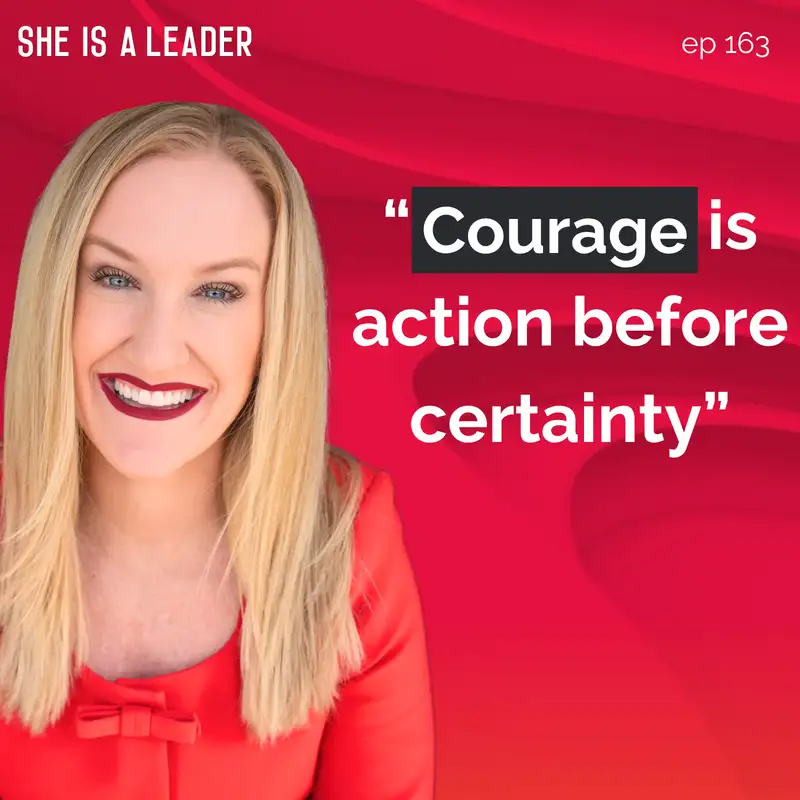
I think, look, we're all, everybody gets stuck in their life like none of us are, you know, I don't know anybody that would say my life, I haven't been stuck in a, in a situation. I think fear is normal at every single level. Whether you're a child or a mid level career, you know, executive or leader or, you know, CEO of a company. Executives don't eliminate fear, they just move that fear. So if you're stuck, you need to move your fear. So what is stuck? I think it's like I fear that if I make the decision I won't, you know, have enough money to feed my kids or if I make that decision, I, you know, won't know anybody in that state or whatever the fear is, but being stuck is really just not addressing your fear. And courage is the is action before certainty. So you have to take a step, any step to get unstuck.
It doesn't matter what the step is. So if it's, you know, I want to get better at whatever it is you have, take a class, ask somebody who's been there. That's a step. And then the next step and the next step and the next step. But movement is super important to get unstuck. You're going to stay stuck in the cement unless you move. If you don't move, your feet are going to be stuck. And there's always, you know, excuses.
Melissa Aarskaug [00:24:18]:
I can't do it because of my husband or my children or my boss or my mom or whatever the the excuses are. You need to step out of the excuses and start solving your own problems. And to your point, nobody's coming to save you. You have people that will help you along your journey, and they're going to support you, but nobody can actually do it for you. You know, it's the same thing. You know, back to, you know, you mentioned my children. I have to teach them to take their own steps, and I have to help guide them in their journey. And it's the same way as we become adults.
We get stuck because of fear, and we get stuck because of past experiences. And oh, my gosh, I tried this one thing one time, or I started this business and it failed. So I can't start another business. Well, the difference between the successful entrepreneurs and the ones that are not are the ones that are successful have probably made a lot more mistakes. And maybe there's a couple who have been successful, and those are, you know, one in millions. But you have to make the mistakes and to get unstuck.
Yvonne Heimann [00:25:26]:
Yeah. What I always say is you can't solve the problem where it's generated. So if we're stuck in our thinking and trying to figure it out, you can run circles in your damn head till you just finally do, because you're not gonna get answers. You're not gonna get a. This works. This doesn't work till you just do. And with that, thank you, everybody, for joining us today for this powerful conversation with Melissa. And if her story resonated with you, if you saw yourself in her struggles, her learnings, and you found hope in her transformation, know that you are not alone.
Leadership isn't about doing it all. It's about building a life and a business that. That supports who you truly are. So if you enjoyed this episode, make sure to subscribe and share it with another woman who is ready to step into her own version of leadership. And remember, your story, your systems and your mindset are the keys to creating the freedom you deserve. Until next time, keep leading with courage and curiosity. Bye everybody.