Yvonne Heimann [00:00:00]
Picture this. You're standing in a room full of investors. You've got the DAC, you've got the data, FTA registration, paying customers, peer-reviewed evidence. You have done everything they told you to do. And they still say no. You fly home, you tell yourself you missed something, you go back over the pitch deck, you tighten the numbers, you practice the answer, you try again. Still no.
You might even start to think the problem is you. You know, that weight, the one that sits on your chest every time you get on a call with a new investor. It has a name. And it's not failure. It's not a gap in your execution. It's a system that was never designed to say yes to you.
My guest today, build a medical device company that hit every single milestone, founders are told, will unlock capital. And she still couldn't close her Series B. What she discovered on the other side of that loss didn't just change her business. It changed what she believed about herself.
You're about to hear something that's going to feel like somebody finally said out loud what you've been thinking for years. So stay with me, because the part that changes everything is coming.
Yvonne Heimann [00:01:31]
This is She Is A Leader, the podcast for women who are done waiting for permission and ready to build, lead, and scale on their own terms. I'm your host, Yvi, and today we are talking with Allison Byers. And Allison.
That story sounds a little bit familiar, just in different areas, doesn't it? Where we do everything we were told. We are checking all the boxes, we are doing all the things, and still we get the fucking middle finger. And not only that, your whole story took that to a whole nother level because I didn't even finish the story yet. Tell my audience what happened after the part of the story that I just told.
Allison Byers [00:02:12]
Yeah, well, you set that up beautifully. My gosh. Listening to her was like, yeah, that's that's what happened. and that's how I felt. So I mean, the end of that story at that company is we ended up selling it. and so there's a whole lot of founders out there that say they are exited. It is true, I'm an exited founder, but it's not a desirable exit. We did something called an asset sale, where another company acquired the assets of our our company, our customers, our team, and then dissolved the rest of it. So it is not how you would prefer. And they then turned around and raised $55 million on those assets. And it just happened to be an all-male team that did that and I just happened to have an all female leadership team and that's that's how that played out.
Yvonne Heimann [00:03:13]
So I'm curious, was there I'm like it's on the paper now, right? I'm like the assets haven't changed. Nothing changed. And suddenly they're able to raise the funding. Was there was that the point where you were like, this game is rigged, something just isn't right here? Or was there evidence beforehand where you are like, what the heck is happening here?
Allison Byers [00:03:36]
No. And so this is why I love, as painful as it is to relive, I love telling this story because up until that point, no, I internalized every failure. Right. I was flying around the country. I had two little kids. I really, I like physically burned myself out trying to make this work. and then when that happened, I thought, wow, I really failed that company. I could not make it happen because clearly it was worth funding so it wasn't until I did some research to understand what did I do wrong, how did I fail, that I uncovered data that told me the system I was playing in and when I had no idea at the time.
Yvonne Heimann [00:04:20]
So you s you mentioned that when the company was dissolved, you took it as a personal failure, right? A lot of us women do that. It's it's our fault, we did something wrong, we used the wrong language, the wrong decks. And let's be honest, as much as we care about branding and decks and visuals, we are the only one that really care that much about it. Nobody else ever gives that much a shit on how stuff looks like than we do. People care about numbers.
Rant end. How long how long did you carry that feeling of it is your personal failure before something shifted?
Allison Byers [00:04:57]
I mean, it was a few months where I I had to recover, right? from what happened. And, you know, when I say I burnt out, it was really bad. Like I I gave myself shingles when I was in my thirties on my face, from stress, right? You're not supposed to get that when you're that young. and you know, had a had a whole lot to process. and you know, to say it was traumatic is really not inflating what happened. It it was for me. And I had a pretty big identity crisis of, well, maybe I'm not as good at business as I thought I was, or maybe I I didn't know what I was doing. and it was a lot of introspection on what was wrong with me for a few months. That's when I looked outward and said, you know what, let me understand this industry of venture capital and fundraising and pitching.
And the whole startup landscape, I had never even thought I needed to research. So it wasn't until I started doing that that I had that switch and that freeing moment of letting go of all of the blame on myself to just going down the rabbit hole of understanding, this is why that happened and this is what I experienced and turned it into, you know, a redemption story to help all of those other entrepreneurs and founders who do what I do because they just don't know the game they're playing.
Yvonne Heimann [00:06:29]
And you mentioned you were collecting all of those data points with getting that knowledge, with finding those data points, with finding the proof that the system is not built for us. What did you do with all of that data? What what happened after that? How I'm like data is great, right? We all want data, but it matters what we do with the data. What did you do with it?
Allison Byers [00:06:57]
Yeah. Well, so I'll give you so one, I'll give you one data point. There's a whole ton of them, but one that really threw me was, you know, I was seeking venture capital as a specific type of money to grow the business. There's all different types of money, and I talk about that a lot now, but for venture capital, if you look at where they allocate their funding, so who do they invest in?
Only zero point six percent of venture capital dollars go to women founding teams. Like it's not just data.
Yvonne Heimann [00:07:30]
You're saying not even one percent, not even one fucking percent.
Allison Byers [00:07:38]
Not even 1%. At the highest it's ever been, it was about 2%, which was during COVID. so it's not just data, it was that where I said, of course, of course I wasn't gonna raise that money. Why would I ever think it was like that? and so, and you're right though, what I I just I mean, I just became obsessed. I I I couldn't learn that and then not look at the flip side of it, which was how much it seems like I can swear on this, how much fucking opportunity is there when that's the distribution? Because we're building and we're creating it.
Yvonne Heimann [00:08:20]
We have the women. We have things are happening. It's not that it's a you don't have enough women-based businesses, right? So part of the conversation and part of the pushback we might be getting, and yes, every episode is marked explicit because I'm Eevee, right? We drop the F bomb. It's not that there isn't female businesses out there. It it's not that there isn't female based startups out there or female board members or anything. The numbers are there. The women are there. So anybody that's like, yeah, you just don't have enough women that are running businesses. That's why it's 0.6. no no no no no no no no. The women are there. The w female based businesses are there. So anybody wanting to jump in the comment section, go do the research.
Allison Byers [00:09:11]
Yeah, and and there it is. The numbers back that up. We are we are here in the population, we are here in the business world, we are here in the startup world, we're here in the net worth and investor world, but we're not playing in that game for a whole lot of reasons that we can get into, or you know, or not, because I I told you I went deep down this rabbit hole. I spent about a year researching all of this.
What I did with it is is I had to do something with it, right? I said, okay, so they're not getting this funding. Well, then how do we? Because the whole world suffers if only one category of people gets to innovate the things that we use in our daily lives. And it's out there, right? So I started a company.
Where we connect founders with the people that open up access and capital for them in a relationship-based manner, because that is how money moves, is through relationships and we have been left out of the rooms where they start. I got involved in policy and co-authored legislation. That's the first law that regulates the venture capital industry. I sit on some boards, I do a ton of advocacy, I wrote a book.
Everything I do is under the umbrella of creating different and more equitable access to innovation capital because I I I just can't let that go.
Yvonne Heimann [00:10:35]
So you just you just described it perfectly. you describe it as a relationship first trust over pattern matching. Now, what does that mean in practice for a founder, especially a female founder, trying to get in front of aligned investors right now?
Allison Byers [00:10:57]
Yeah, so there's a basic human bias that we all have, all of us, right? Bias is not always bad and venture is like, yeah, not malicious. I don't think anyone is I mean, some people are, but I don't think the majority of people are out there like, we're not gonna let the women have the money today. You know, I don't think that's what's happening, but we
Yvonne Heimann [00:11:18]
It's it's human nature. I'm like to to dive into the psychology for a second so my listeners and everybody that's watching the show understands boxes are what have kept us safe in the past, right? Whatever we know is safe to us. Now you can take that into relationship, which why certain people stay in abusive relationships because abusive is what they know. They suddenly feel unsafe when they're in a safe relationship.
So I'm using that as an example because it's often something that everybody has seen or experienced in some way, shape, or form. So with that, we all carry a bias. We all do based on what makes us feel safe. It's just human nature. And also the moment we realize that's what human nature is, that's what just automatically happens, we now suddenly have.
That knowledge and can see where we potentially experience bias.
Allison Byers [00:12:25]
Yeah, that's a great, I mean, I hadn't even made that parallel, but you're right. What you're talking about is the familiarity bias. And there are multiple of these psychological principles and bias principles that we all carry with us. And so familiarity bias is where we view things that are familiar as safer, right? And we view things that are not familiar to us as risky. And when it comes to investing or money, you always, if you're the one providing the money, you start from a place of risk. You're always assessing risk. And so if you are a female founder, to go back to your question, out there looking for investors, if you are going to investors where you are not familiar, which is the majority of the venture capital industry, not 100% of it, but 93% of check writers are still white men, in VC specifically.
If you're only focusing there, you're going in with higher risk to begin with. And familiarity doesn't have to be along demographic lines, but oftentimes that's where it does end up. So one of the biggest things I talk about is broadening your scope of thinking about where to access money. Because the broader your scope is of potential sources. The more familiarity potentially exists for you to go to, and you increase your odds because you are less risky, and so...
My, you know, what I talk about a lot is when I studied this, if venture capital is not accessible by most people, well, what's the next largest source of capital? Where else does money live? and it's with all of us, it's private wealth. It dwarfs venture capital. If you look at it in sum, but it's disparate, it's all over the place, but that also is what makes it more accessible because you can find people who share something with you where you are familiar, either what you're working on or who you are. And it becomes more enjoyable to do that as well.
Yvonne Heimann [00:14:38]
And it's there is so much that goes into this because I think when it comes to raising capital, what the general public has in mind that hasn't been exposed to it is either VC capital, which is the venture capital, which is like it's risk assessment. That's all it is, let's be honest. It's like you look at numbers, you you you look at the people involved and you assess the risk. I've, my late husband has done some pictures. I'm like, you go. I don't even want to deal with those people. some of my audience might have heard about angel angel investment, which I think you are also an angel investor. And then th some people might have heard some of that. And then the rest we kind of perceive right now is kind of like the the go fund me and Kickstarter kind of.
Fundraising like YagoFundMe is is supposed to be donation based. Sometimes it's being abused for other situations. But like Kickstarter and Kickstarter is difficult because especially if you were building something and building that community, building community is some of the most difficult piece of everything, right?
Is there from our perspective, right? When when we think about everybody normal people, quote normal people that haven't been in raising capital or anything. Talk to me about the in-between. What I mean by that is when I think raising capital, I think about big tech startups that are building a new AI and going to be a membership platform. It's it's sorry, when I hear about finance, when I hear about VC, it seems to be always tech. Maybe because I'm in that niche.
I would love to to break that mold, to break that bias a little bit, because I have a little bit of an inkling that that bias of mine is not true. It's not just tech startup, it's not just the go the bros. I do believe there is an in between. There is an in-between the tech startup and what we see on social media, and my god, we have another unicorn and the Kickstarter campaign. What is that in between?
Allison Byers [00:16:56]
Yeah, I mean the in between is most businesses, right? Like it's it's most of us. I mean if you really think about, you know, when we talk about the bros or the tech or VC or whatever, VC is a model that is its own business.
It's in the business of investing and growing other people's money. And that's part of why it is such a mismatch for most businesses, for the in-between. It was never meant to power all of our innovation. It was only meant to power business models that could grow very fast and be sold in five to seven years.
So that the business of the venture fund can then return profits to its investors, which is where it has fiduciary duty, not to the startups it invests in. That's one of the key things to understand. Their incentives are to their investors, not to you. Doesn't make them bad or evil, but you have to understand their business, right? Which is one of the things that I did not understand in my last company.
You don't have to be a mythical unicorn or a rocket that crashes and burns to be a successful business and to make an impact in bettering society or providing things of value to the population. You get to be whatever business you want to be. You started it, right? You decide what you want to do. No one else dictates your own business journey if you don't want them to. And so it is so critical to think: well, how am I funding it? And whose money am I taking? And what do they need and want out of it? Because if they need and want things that I don't want to do, don't take that money. And if you have a slower growth, you have a slower growth. And okay, you have a happier life.
Yvonne Heimann [00:18:50]
And I would love to follow up with this again, just assuming we don't know, right? I'm assuming pretty much that the audience at this point is like, wait a second. No normal normal business can raise funds too? Because it's like, let's be honest, getting money from a bank is a pain in the ass at this point. and
I also believe that a lot of female founded companies are more mission and passion driven than others. We wanna have an impact, we wanna change something, we wanna make the world a better place in whatever way we do so.
Allison Byers [00:19:33]
Yeah, well, I you know, I think a lot of it is because we haven't had innovations that address what we need and we see all of this opportunity to fill, right? Like yes, it is true. We we do tend to be more social mission driven. I'm an example of that, you're an example of that, but it's because there are so many things to solve for that it's all it's all opportunity.
Yvonne Heimann [00:20:00]
And I love that you build your company again around community, around relationship, around exactly this, where I assume, not having been involved with your company directly, where these conversations happen, where it's like, okay, even in our mission-driven, these don't necessarily fully align. There is there is a misalignment with the the capital goal and our goal as a company, however, we have other resources and we can match them more again on a relationship level, on a personality level, on the aligned values and and the aligned mission of the thing we want to do.
Allison Byers [00:20:42]
Yeah, completely. I mean, look, any successful business is successful because it drew the right people around it. Right? We're everything's powered by us. We're the humans driving it. And humans run on, like we already talked about, relationship and trust. So community building.
Is about building relationships and trust that don't have ulterior motives. And I think this is a piece that, I mean, it's what I'm building my company on, but a piece that a lot of particularly women entrepreneurs, whether you're doing a scaling startup or a solopreneur business or whatever it is you're building, we think that we need to wait until we need something to reach out to someone. Right. I know like for me
Yvonne Heimann [00:21:29]
I just felt that.
Did you just call me out?
Allison Byers [00:21:37]
Maybe call myself out. Right? Because but it comes from a good place. We don't want to waste anyone's time. Right. Like we think it's respectful to wait until we have an ask and then you reach out to someone. But the problem is that's not how business actually works. It's not how it's worked for the guys. It's not how they open doors for each other because they already know each other. They already have trust. And when we wait until we need something.
We're compressing the trust building into a transaction and it doesn't work. It doesn't work that way. It becomes superficial. And that's the root of community, is it's not superficial and it's not transaction-based.
Yvonne Heimann [00:22:22]
But I never thought of it in the sense of raising capital. And like, let's LinkedIn is the perfect counterexample, right? It's like connecting with somebody on LinkedIn and two hours later you suddenly have a fucking pitch in your inbox. It's the perfect example, right? It's the perfect transaction example. And I think why this hits so much right now, because yes, I completely agree. I want to build the community, right? I want to have the conversation with women.
That are aligned with me, that have similar goals, that have similar values to me, and have that community, which can be really difficult to build. And I never thought of it in the sense of finance, of capital, of raising funds. Because why would I talk to an angel investor when I don't have the ask? But you're right.
Allison Byers [00:23:14]
Yeah. Cause an angel investor is just a person, right? Like if you take my example you started with, you can't just all of a sudden raise fifty-five million dollars. That discussion had already happened. They already knew each other, right? We have to know each other.
For women in particular, and you know, I don't focus solely on women, but obviously that's my lived experience, and we're half the population. for women in particular, we have not in the US legally been allowed to fully participate in the investment or business ownership space until very recently, until the 80s. so of course we're not comfortable. I know.
Yvonne Heimann [00:23:50]
Yeah. I was born in the eighties. I'm like, really?
Allison Byers [00:24:00]
Yeah, we were not. I think it's you can fact people will fact check me. I think it's eighty-eight, if I'm remembering correctly, was when we legally were allowed to open a business loan without a male relative's co-signature. Like yeah, I think I was I'm pretty sure like I was seven when that happened. So yeah, so we don't we don't have generations past that we're building our relationships on, right? It it doesn't exist. And we don't have people to look to who were in the capital provider space. It didn't exist. It's why we are so comfortable in philanthropy. That's where we were allowed to participate. It feels familiar. So it is a relationship game. You do have to talk to people who can not just maybe write a check, but who provide access to all kinds of capital. Financial's one of them. So is building, so is network, so is social. They all play together, but they all come after trust and after the relationship. And we can't wait until we need those things.
Yvonne Heimann [00:25:05]
So baffled by my own disconnect right now because it's so obvious. See, this is one of these things where it's like once you hear it, it's so freaking obvious. And I'm like, so much, so much for I'm always logical. Now, even no but none of us is perfect, right?
Allison Byers [00:25:25]
Hey, it doesn't look it took what happened to me, the story you started this. It took that for me to figure this out. It's been years. It it's not it's not something we would naturally go to.
Yvonne Heimann [00:25:35]
You don't you don't you don't see Yvi quiet and baffled often. And yeah, this is one of those moments where I'm like, duh. It's one of those duh moments, really. Yeah. Makes complete fucking sense. Really, Evie? my god. I have a feeling I already know the answer, but I love this question always at the end. Because we always end with an action item. We always can learn, we always can read, we always can listen if we don't take action on it.
What are we doing here? So for the founder, and we are a female-based podcast, so specifically for the female founders listening right now who are just got another no or considering going into actually raising capital. And we always take everything personal, right? So she might be right now in the moment of great, I'm it's just not my thing. She is ready, she is, she is close to the point of where you were of, I'm giving up, I'm done. What's the one thing you tell her to do this week? Before the next pitch, before doing anything else, what should she do this week?
Allison Byers [00:26:45]
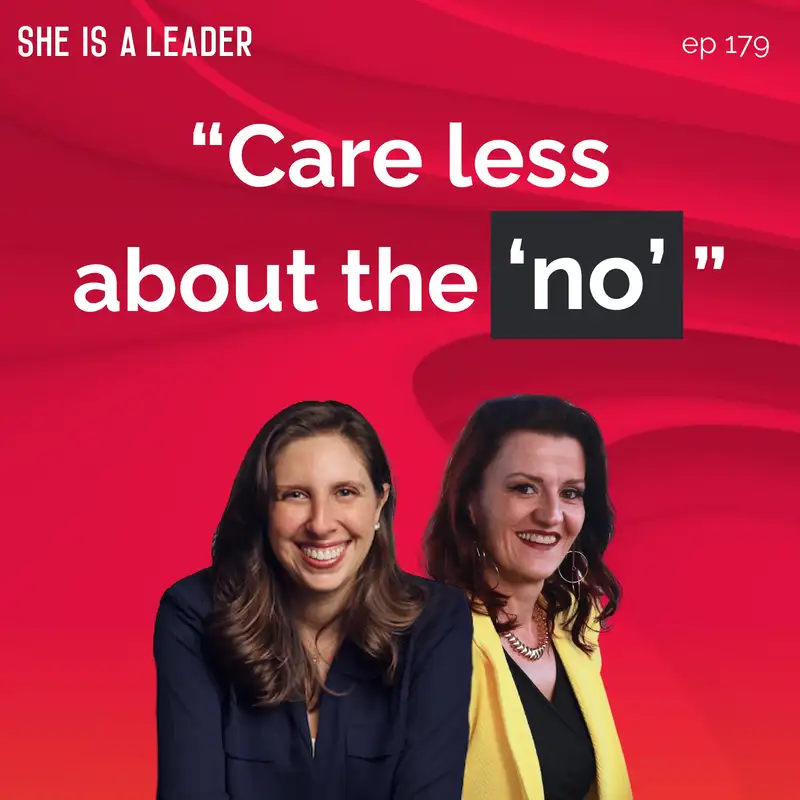
Okay, this is my best advice. I'm looking right in my camera so I can make eye contact with all of you watching. Care less. Not kidding. Care less about someone who says no. You are not out there to convince people that what you're building is worthwhile or that you are a good steward of their money. You need to go find your people.
If someone says no, fine. They're not your source of money. Go expand how you think about it. Find the people where you say what you're doing and they meet you and they get it. And you don't have to convince them. Those are your people. Care less. You'll have a whole different level of confidence when you go into conversations.
Yvonne Heimann [00:27:20]
Alison worked us in Allison walked into a system that wasn't built for her or us, to be honest. And instead of trying harder to fit in, she just went ahead and worked on changing it. So if you've been carrying a rejection that felt personal, take it back. As she just said, care less. The no wasn't about you. And Allison's book, Fundraising for the Rest of Us, is out. So go grab your copy.
Go check her out. We have all the links in the section. You know the game. And if this hits close to home, if you have the same baffled moment like I just had, go share this episode with a woman who might have experienced the same, this is my fault, bullshit, who's ready to raise capital herself and needs to just hear this and needs to just know it's not your fault.
And we are ready to change the system. I'll see you in the next episode. Alison, thank you so much for joining me today and thank you for changing the system.
Allison Byers [00:28:45]
Thank you for having me on.